Dishwasher vs Washing Up by Hand: Which Costs Less in 2026?
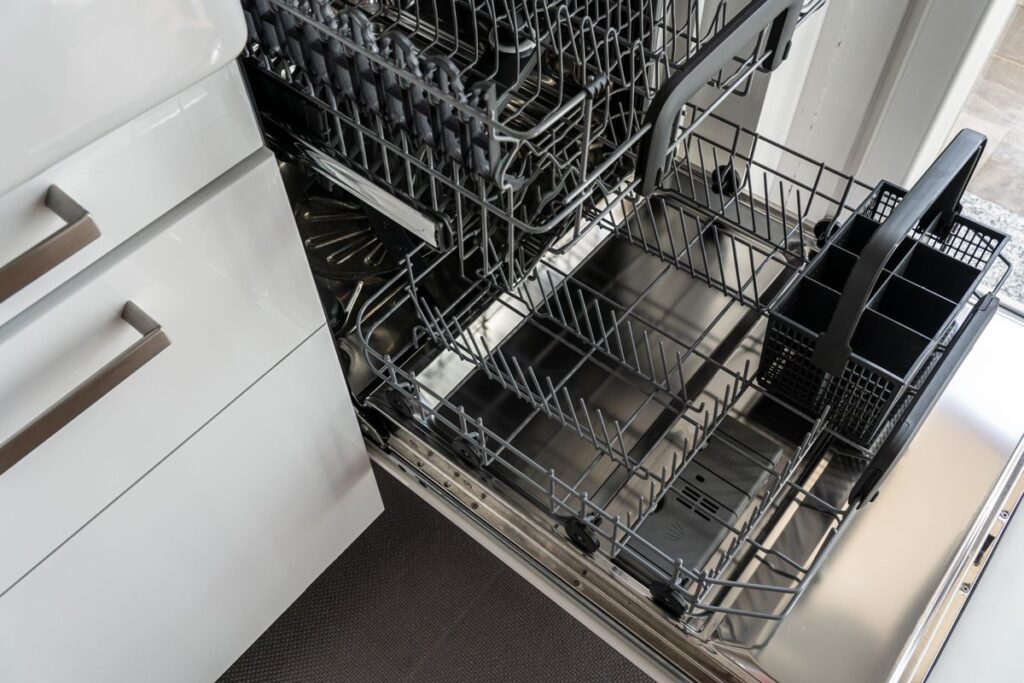
Quick answer: A full dishwasher on an eco cycle uses about 0.85kWh — 22p at the current cap — plus around 10 litres of water. Washing the same load under a running hot tap costs about 18p in gas-heated water but uses nearly 50 litres; a careful washing-up bowl is cheapest of all at around 4p.
All costs on this page are calculated at the October–December 2026 Ofgem price cap for Direct Debit customers: 26.32p per kWh of electricity, with gas comparisons at 7.97p per kWh. Unit rates vary slightly across the 14 GB regions, so treat these as good averages and check the rate on your own bill.
The sums: machine electricity vs hot tap water
The dishwasher side is easy: a modern full-size machine’s eco cycle uses roughly 0.85 kilowatt-hour, so 0.85 × 26.32p ≈ 22p. The hand-washing side is really a hot water sum. Heating one litre of water by 35°C takes about 0.04kWh of heat, so two washing-up bowls (≈10 litres) need ~0.41kWh; supplied by a gas boiler at ~85% efficiency that’s ~0.48kWh of gas, costing about 3.8p. Wash under a running hot tap for eight minutes (≈48 litres) and the same maths gives ~2.3kWh of gas — about 18p — or a hefty 51p if your hot water comes from an electric immersion instead.
Cost per wash-up, method by method
| Method | Energy used | Cost | Water used |
|---|---|---|---|
| Dishwasher, eco cycle (full 12-place load) | 0.85 kWh electricity | 22p | ~10 litres |
| Dishwasher, normal 65°C cycle | 1.2 kWh electricity | 32p | ~14 litres |
| Washing-up bowl ×2, gas-heated water | ~0.48 kWh gas | ~4p | ~10 litres |
| Running hot tap, 8 min, gas-heated | ~2.3 kWh gas | ~18p | ~48 litres |
| Running hot tap, 8 min, immersion-heated | ~1.95 kWh electricity | ~51p | ~48 litres |
Figures assume a 35°C temperature lift on incoming mains water and a typical modern dishwasher; older or smaller machines vary.
So which should you use?
If you’re disciplined with a bowl, hand-washing with gas-heated water is the cheapest option in pure energy terms. But the honest comparison for most households is a full eco-cycle dishwasher (22p) against washing under a hot running tap (18p in gas, five times the water, plus your time) — and there the dishwasher is excellent value, especially if your water is metered or your hot water is electrically heated, where it wins outright. Over a year, five eco cycles a week comes to about 221kWh, or £58 — against around £67 of gas for a daily running-tap wash.
The pre-rinse trap and other easy wins
- Skip pre-rinsing under the hot tap — it can quietly add more energy than the cycle itself. Scrape plates instead.
- Only run full loads: a half-full machine costs the same 22p.
- Use eco mode as the default — it washes cooler for longer, which is where the saving comes from.
- On an off-peak tariff, run the dishwasher overnight; our Economy 7 and Economy 10 guide explains the timing.
- The same full-load logic applies to laundry — see our guide to washing machine energy ratings.
On a water meter? The gap widens
Everything above prices the energy only. If your home is on a water meter, the volumes matter too: a running-tap wash uses roughly 38 litres more than a dishwasher cycle, and at one wash-up a day that’s around 14,000 litres — 14 cubic metres — a year. Metered water and sewerage are charged per cubic metre at rates that vary by supplier, so check your bill, but the direction is clear: metered households have an extra reason to prefer the machine over the hot tap. Unmetered households pay the same regardless, which nudges the pure-energy comparison back towards the washing-up bowl.
Older machines: how to check what yours really uses
The 0.85kWh eco figure describes a reasonably modern full-size machine; a fifteen-year-old dishwasher can use half as much again, and compact models differ too. The energy label (or the manual, or the manufacturer’s site) lists per-cycle consumption for the standard programme, and a smart plug with energy monitoring will settle the question for any cycle you actually use. If your machine predates energy labels worth reading, its per-cycle cost is worth knowing before you assume the dishwasher is winning — and when it eventually dies, per-cycle kWh is the number to compare on the shop floor, just as it is for a washing machine.
One last habit worth naming: the “rinse and hold” or pre-wash programme. It feels thrifty but runs the machine — pump, water and sometimes heat — for dishes you’ll wash again anyway. If plates will sit for a day or two before the machine fills, a scrape and a stack does the same job for nothing, and modern detergents are formulated to work on dried-on food. Small habits, repeated daily, are exactly how kitchens quietly gain or lose a tenner a month.
FAQs
Is eco mode really cheaper if it runs for three hours?
Yes. Cycle length and energy use aren’t the same thing — eco cycles heat the water less and skip aggressive drying, which is where most of the electricity goes. The 0.85kWh eco figure beats the 1.2kWh normal cycle despite taking longer.
How much water does a dishwasher use compared with hand-washing?
A modern full-size machine uses around 10–14 litres per cycle. A running hot tap gets through that every couple of minutes, so a tap-washer can easily use four to five times as much water for the same stack of dishes.
Does it cost much more to run the dishwasher half-full?
The cycle costs the same regardless of load, so a half-full wash effectively doubles your cost per item. Waiting for a full load is the single simplest saving — and if you can’t wait, most machines have a genuine half-load or top-basket-only programme worth using. Our plain-English bill guide shows how to spot what your kitchen appliances add up to.
What would an upgrade save you?
Pick an upgrade and your region — instant modelled cost, annual saving and payback, from the same dataset behind our local guides.

Related Articles

Best electric heating for a flat with no gas, ranked by running cost
No gas supply doesn't mean expensive heating is inevitable. Air-to-air heat pumps, storage heaters, infrared and panel heaters ranked by what they actually cost to run.
14 October 2026
Storage heater settings for winter: input, output and Economy 7 timing
Input fills the bricks with cheap overnight heat, output spends it. Set them the right way round and Economy 7 works as promised. The winter baseline settings, scenario by scenario,…
14 October 2026
Best combi boiler for a small flat: compact, low-output picks
Small flats need small, quiet combis that fit a kitchen cupboard and don't short-cycle on four radiators. Our picks with prices, dimensions and warranty terms.
12 October 2026