Heat Pump Noise Regulations and Planning Rules in Lancashire
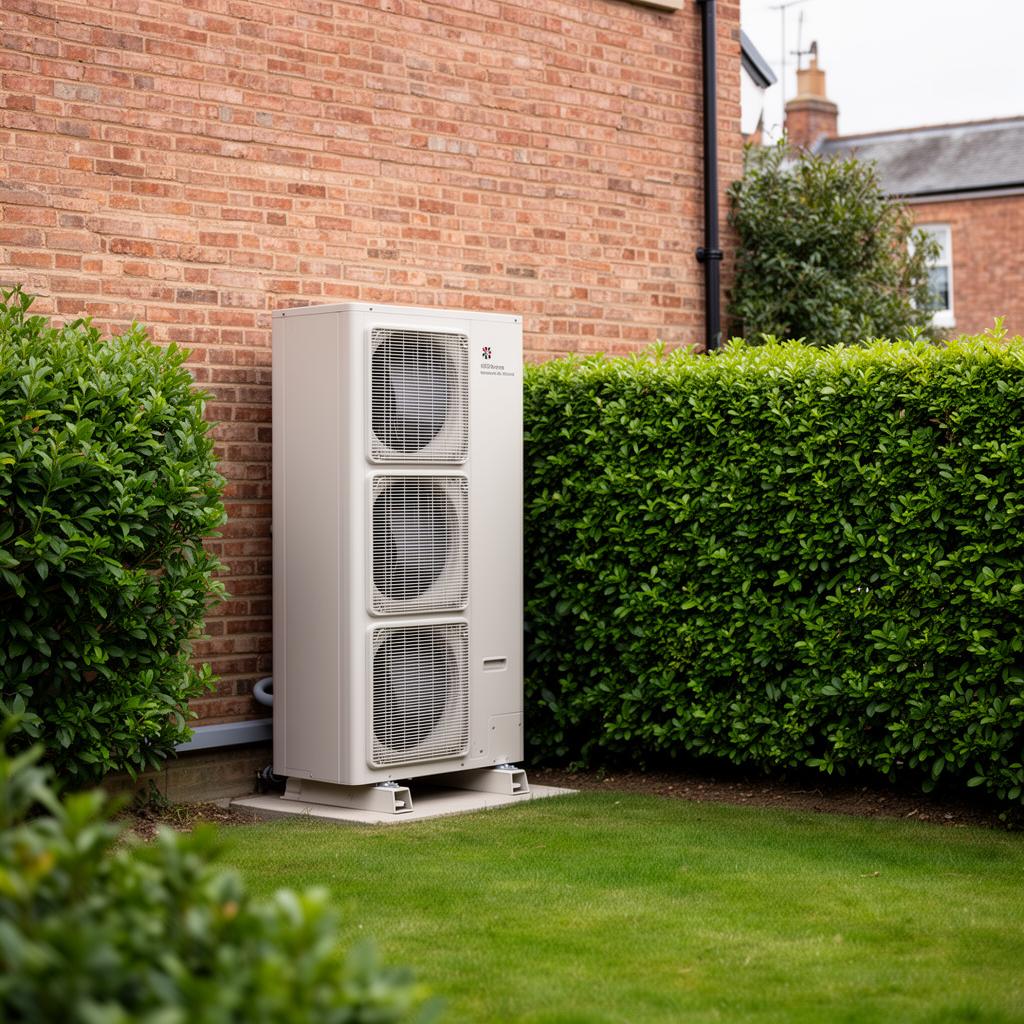
Heat pump noise is the concern that comes up in almost every conversation with Lancashire homeowners considering a switch from gas. Modern air source heat pumps produce 40 to 60 decibels at one metre – roughly equivalent to a running refrigerator at the lower end or a conversation at the upper end. The legal limit under permitted development rules in England is 37 decibels, measured one metre from the nearest neighbour’s habitable room window or door. Meeting this threshold takes a quiet unit and careful placement: with a neighbour’s window three to five metres away, the unit needs to measure no more than about 46 to 51 decibels at one metre, and some Lancashire property layouts need specific mitigation measures too.
What Are the Noise Regulations for Heat Pumps in the UK?
In England, planning rules under Permitted Development allow air source heat pumps without planning permission provided the unit does not exceed 37 decibels (dB) one metre from the nearest neighbour’s habitable room window or door. Since 29 May 2025 the heat pump no longer has to be one metre from the property boundary, and a detached house may have two units (other houses one). In conservation areas or listed buildings, a full planning application is required regardless of noise levels.
Most modern air source heat pumps produce 40 to 60 dB at one metre, and the quieter models listed below measure 45 to 55 dB. Lancashire installers typically position units away from neighbours’ windows and use anti-vibration mounts to keep noise within the 37dB limit; with a neighbour’s window only a few metres away, that usually takes a unit from the quieter end of that range. If your property is in a conservation area such as parts of Clitheroe or Lancaster, your installer should submit the planning application on your behalf before work begins.
The 37dB Rule: What It Means in Practice
Under the Microgeneration Certification Scheme (MCS) requirements and permitted development rights, an air source heat pump must not produce more than 37 decibels (dB(A)) when measured one metre from any habitable room window or door of a neighbouring property. That is the MCS 020 a) standard, which permitted development in England has required since 29 May 2025. It replaced the old MCS 020 calculation, which used a 42 dB(A) figure that included background noise. This measurement uses A-weighting, which adjusts for how human ears perceive different frequencies.
Sound decreases with distance – roughly 6dB for every doubling of distance from the source. So a heat pump producing 55dB at one metre will measure approximately 49dB at two metres, 43dB at four metres, and 37dB at eight metres. For most Lancashire properties where the outdoor unit is positioned three to five metres from the nearest neighbouring window, meeting the 37dB limit needs a unit measuring no more than about 46dB at one metre if it is three metres away, or 51dB if it is five metres away.
However, Lancashire’s housing stock includes many terraced and closely-spaced semi-detached properties where the distance to a neighbour’s window can be as little as two to three metres. In central Blackburn, Burnley, Accrington and Bolton, back-to-back yards sometimes measure just three to four metres across. In these situations, unit selection and placement become critical.
Permitted Development: When You Do Not Need Planning Permission
Most domestic air source heat pump installations in Lancashire qualify as permitted development, meaning no planning application is needed. The conditions for permitted development in England are: the unit complies with MCS planning standards (including the 37dB noise limit), there is only one heat pump at the property (two on a detached house), the unit volume does not exceed 1.5 cubic metres on a house (0.6 on a block of flats), it is not installed on a pitched roof, and in conservation areas or on listed buildings, it is not visible from a highway. Since 29 May 2025 it no longer has to be one metre from the property boundary.
For the vast majority of Lancashire installations – a unit in the back yard, side passage or garden of a standard residential property – these conditions can usually be met, though the 37dB noise limit may need a quieter unit or careful siting where a neighbour’s window is close. Your MCS certified installer will confirm permitted development compliance as part of the installation process and include this in the MCS notification to Building Control.
Properties in conservation areas need extra consideration. Parts of Clitheroe, Whalley, Longridge, Garstang, Lancaster and several other Lancashire towns have conservation area designations. In these areas, the unit must not be installed on a wall or roof that faces a highway. Rear and side installations are usually acceptable, but check with your local planning authority if you are uncertain.
When Planning Permission Is Required
You will need a planning application if: you cannot meet the 37dB noise limit through unit selection and placement alone, the unit is larger than 1.5 cubic metres (0.6 on a block of flats), the property is listed, or you want to install the unit in a position that does not meet permitted development criteria.
Planning applications for heat pumps are generally straightforward and have high approval rates across Lancashire. The application fee in England is £548 (from 1 April 2026), and the typical processing time is eight weeks. Your installer can advise on whether planning permission is needed and may assist with the application.
If planning is needed because a permitted development condition can’t be met, the application will be assessed on noise impact, visual impact, and any other relevant factors. Including a noise assessment from the heat pump manufacturer showing compliance at the nearest sensitive receptor usually satisfies the noise concern. Visual impact can be mitigated with screening or planting.
Choosing a Quiet Heat Pump for Close Neighbours
Noise levels vary significantly between heat pump models. Some of the quietest units currently available include:
- Vaillant aroTHERM plus: 46 to 54dB at one metre depending on the size, with a night setback mode reducing to 39 to 44dB
- Samsung EHS Mono: 46 to 52dB, with an ultra-quiet mode available on newer models
- Grant Aerona3: 48 to 55dB at standard operation
- Daikin Altherma 3: 45 to 52dB, with a quiet mode reducing output by 3 to 5dB
- Mitsubishi Ecodan: 45 to 55dB depending on model and operating condition
These figures are measured at one metre from the unit. At the four to five metre distance typical of most Lancashire installations, the sound drops to 34 to 43dB. To stay within the 37dB limit, a unit four metres away needs to measure about 49dB or less at one metre, or 51dB or less if it is five metres away, so choose from the quieter end of these ranges. Units with night setback or quiet modes can reduce noise further during sleeping hours, which is particularly considerate in residential areas.
Newer R290 propane models tend to be slightly quieter than their R410A predecessors at comparable output levels, which is another advantage of the latest refrigerant technology.
Noise Mitigation Techniques
If your preferred location does not achieve the noise limit with the chosen unit alone, several mitigation measures can help:
Acoustic barriers or fencing between the unit and the neighbour’s property can reduce perceived noise by 5 to 10dB. A solid fence or wall with no gaps is most effective. The barrier needs to be taller than the line of sight between the unit and the neighbour’s window. Acoustic fencing panels designed for this purpose cost £200 to £500 per section.
Anti-vibration mounts prevent the unit from transmitting vibration into the ground or a wall, reducing low-frequency hum. These cost £50 to £150 and are standard practice for most quality installations. Concrete plinths with anti-vibration pads are more effective than mounting directly onto paving slabs.
Positioning the unit so the fan discharge faces away from neighbouring properties reduces perceived noise, as heat pumps are louder at the front (fan side) than the rear. If the unit can be positioned with a solid wall between it and the nearest sensitive window, the wall provides significant acoustic shielding.
What About Your Own Noise Experience?
The regulations focus on neighbour impact, but your own comfort matters too. If the unit is positioned outside your bedroom window, you will hear it at night when it operates for heating and hot water. At 40 to 50dB through a closed double-glazed window, it is typically a gentle background hum – similar to a fridge. Most people stop noticing it within a few days.
If you are noise-sensitive, position the unit away from bedroom windows where possible. Side passages away from living and sleeping areas are ideal. For terraced properties with limited options, asking your installer about units with quiet night modes is a sensible precaution.
The defrost cycle can produce a slightly louder whooshing sound for 2 to 5 minutes every 30 to 90 minutes during cold, humid weather. This is temporary and normal but can be noticeable at night if the unit is close to a window. Some modern units have gradual defrost modes that reduce the acoustic impact of defrost cycling.
Dealing with Neighbour Concerns
Speaking to your neighbours before installation is good practice and can prevent complaints later. Explain what a heat pump is, where it will be positioned, and what it sounds like (showing them the manufacturer’s noise data helps). Most neighbours are understanding, particularly when the alternative is continued fossil fuel heating. Offering to show them the unit after installation can also help – people are often reassured when they hear how quiet modern units actually are.
If a neighbour does complain after installation, the first step is to check whether the unit meets the 37dB limit at their window. Your installer should have documented this as part of the MCS process. If the unit is compliant, you have met your legal obligation. If it exceeds the limit, your installer is responsible for providing mitigation to bring it into compliance – this is part of the MCS certification requirement.
How loud is a heat pump compared to a gas boiler?
A gas boiler flue produces about 40 to 50dB at one metre, similar to a heat pump. The difference is that a boiler is inside the house (with noise contained by walls), while a heat pump is outside (exposed to neighbours). However, at four to five metres distance, a modern heat pump produces 34 to 43dB, which is quieter than typical background noise in most Lancashire neighbourhoods.
Do I need planning permission for a heat pump on a terraced house?
Possibly. Since 29 May 2025 the outdoor unit no longer has to be one metre from the property boundary in England, but you will need planning permission if it can’t meet the 37dB noise limit at a neighbour’s window, which is harder in tight terraced yards. The application is straightforward and usually approved, especially with a noise assessment demonstrating compliance. Your installer will advise whether permitted development applies or whether a planning application is needed.
Can neighbours object to my heat pump?
Neighbours can raise concerns, particularly during a planning application. If the installation meets the 37dB noise limit at their nearest habitable window and complies with permitted development or planning conditions, their grounds for objection are limited. Proactive communication before installation, considerate unit placement, and using the quietest available model reduce the likelihood of complaints.
Which grants can you actually get?
Six quick questions, answered entirely in your browser — nothing stored, nothing sent. Covers the Boiler Upgrade Scheme and every devolved alternative.

Related Articles

Grant vs Samsung heat pumps: the value head-to-head
The Aerona 290 and the EHS Gen 7 are the two value picks of the UK heat pump market, priced within £80 of each other. We compare specs, warranties and…
13 October 2026
Combi boiler vs heat pump hot water: what actually changes
Hot water is where combi owners hesitate over heat pumps. The running costs are nearly level; the real trade is on-demand convenience against a cylinder that runs two showers at…
11 October 2026
Bosch Compress heat pump review UK: 5800i vs 7400i
The Bosch Compress 5800i AW pairs R290 and 75C flow with a 41.5 dB(A) sound power figure, the lowest we've seen published. We compare it with the outgoing R410A 7400i…
8 October 2026