Solar roof tiles vs panels: UK costs and the in-roof option
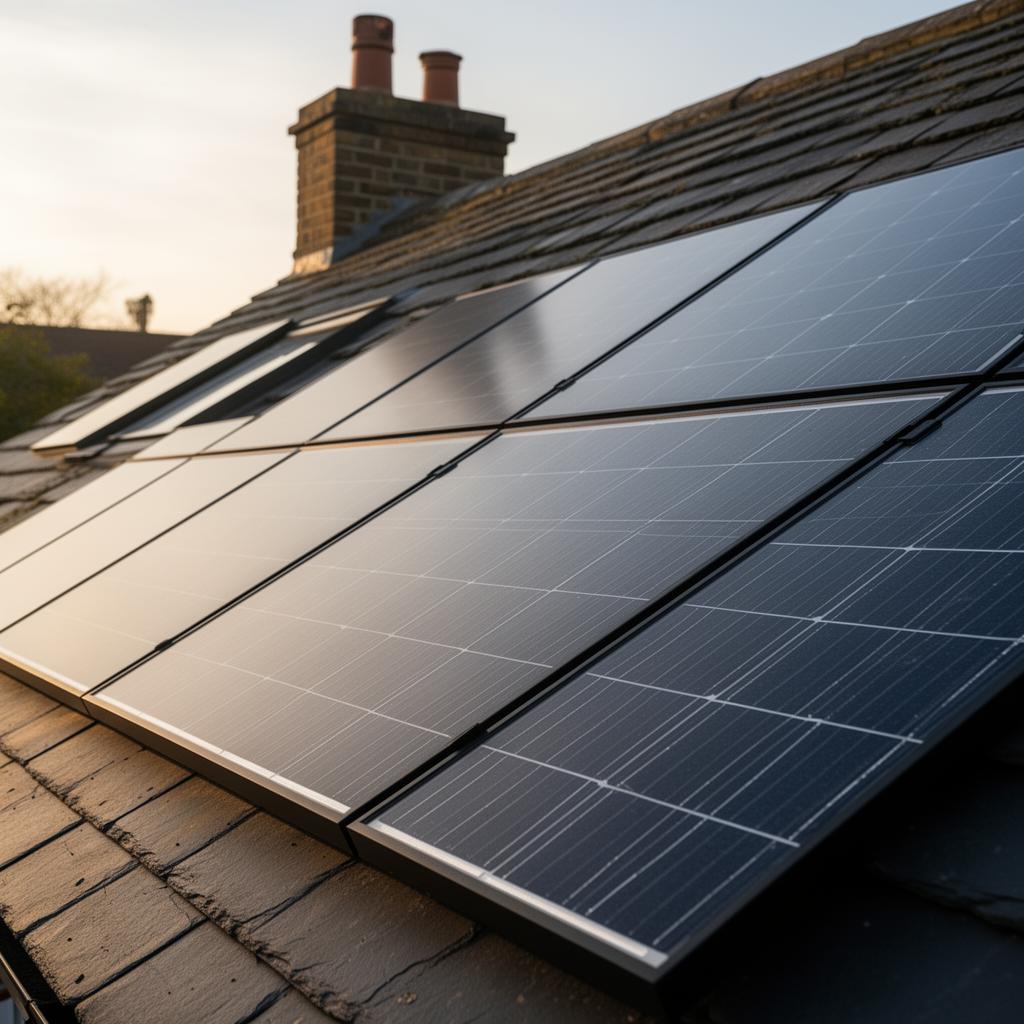
Quick answer: Solar roof tiles cost roughly £3,000 to £3,700 per kWp installed, so £12,000 to £13,000 for a typical 3.5 to 4kWp system (The Eco Experts; Sunsave). That’s about double on-roof panels, where the 2025/26 median was £1,780 per kW (DESNZ). In-roof panels cost about the same as on-roof on a new build and 30% to 60% more as a retrofit.
There are three ways to put solar on a pitched roof, and most comparisons blur two of them. Get the distinction right and the cost question mostly answers itself.
Solar tiles, in-roof panels and on-roof panels: what’s the difference?
On-roof is the familiar system. Hooks go under the tiles onto the rafters, rails run across them, and the panels sit a few centimetres above the roof covering.
In-roof (also called integrated or roof-integrated PV) uses ordinary-sized panels, but they sit in weatherproof trays that replace a rectangle of tiles or slates. The panels become the roof surface. GSE’s In-Roof System takes panels in portrait or horizontal format, with or without a roof window (GSE Integration). Viridian’s Clearline fusion works with “all common tiles and slates” and carries a BBA certificate covering the whole system (Viridian Solar). Edilians sells the Easy Roof kits in the UK (Edilians). If you’ve searched for solar panels instead of roof tiles, in-roof is almost certainly what you want.
Solar tiles and solar slates are small generating units laid in courses like the roof they replace. GB-Sol’s PV Slate is 30W and replaces four 500 x 250mm natural slates (GB-Sol). Tyle’s tiles are 100W each (The Eco Experts).
One naming trap. Marley’s SolarTile isn’t a tile-sized unit at all. The 445Wp version measures 1,134 x 1,722mm and is 23.6% efficient (Marley), so it behaves like an in-roof panel that clips into Marley’s own roof system.
| On-roof panels | In-roof panels | Solar tiles or slates | |
|---|---|---|---|
| Cost per kWp | £1,780 median (0 to 4kW, 2025/26) | Same as on-roof on a new build; 30% to 60% more as a retrofit | About £3,000 to £3,700 |
| Typical 4kWp system | About £7,100 | About £7,100 new build; roughly £9,200 to £11,400 retrofit | £12,000 to £13,000 |
| Output per square metre | About 228W (22.8% panel) | Same panels, same output per m² | 150W for PV Slate (15%) |
| Heat loss vs on-roof | None, air gap behind | 3% to 10% quoted | Lower efficiency to start with |
| Fixing a faulty unit | Unbolt from the rails | A roofing job as well as an electrical one | Depends on the maker still supplying that format |
| Best for | Most homes with a sound roof | New builds, re-roofs, sensitive streets | Re-roofs where the roof must still read as tile or slate |
Sources are in the sections below. The retrofit in-roof band applies Reonic’s 30% to 60% uplift to the £7,100 median, so it’s a range, not a price.
How much do solar roof tiles cost in the UK?
The Eco Experts puts an average 3.5kW solar tile system at around £13,000, roughly double a conventional system (The Eco Experts, page updated 18 August 2026, cost table dated April 2025). Sunsave quotes the Energy Saving Trust at around £12,000 for a typical 4kWp tile system, about £3,000 per kWp before scaffolding and stripping the old roof (Sunsave, updated 25 June 2026). For a complete GB-Sol solar roof, Spirit Energy says the price “can approach £3,000 per kWp” (Spirit Energy).
Compare that with the government’s own figures. The median cost of a 0 to 4kW solar installation in 2025/26 was £1,780 per kW, across a record 265,682 installations of up to 50kW (DESNZ solar PV cost data, May 2026). A 4kWp on-roof system at that rate is about £7,100. Our own cost index puts the typical system of 10 to 12 panels at £6,320 (solar panel costs).
Tile makers frame it differently. Tyle’s own indicative figure is £1,500 per kWp for its tiles against £1,250 for premium in-roof, but only on a roof that’s being replaced anyway, and it excludes the roof itself (Tyle, August 2026). On a roof that doesn’t need replacing, you pay to strip good tiles before a single watt goes up.
Installed solar is zero-rated for VAT until 31 March 2027, whichever format you pick. But HMRC says building work that’s a separate supply can be standard-rated (HMRC VAT Notice 708/6). On a combined re-roof and solar job, ask how the invoice splits. Our 0% VAT guide covers what qualifies.
What does in-roof cost compared with on-roof?
It depends almost entirely on timing.
On a new build, the trays replace tiles the builder would otherwise buy. Spirit Energy prices the GSE system at about £1,200 per kWp excluding VAT and scaffolding on new builds, “on a par with the cost of an on roof system”, with Viridian’s kit just under £200 per kWp more (Spirit Energy). The Eco Experts agrees the costs are similar (The Eco Experts).
Retrofit onto a healthy roof and it’s a different job. Reonic, which makes design software for installers, says in-roof kits typically add 30% to 60% to the install cost on a retrofit (Reonic, July 2026). The money goes on stripping tiles, fitting and flashing the trays, and extra days of roofing labour. The panels themselves are the same.
Scaffolding is the quiet reason re-roof numbers look good. It’s in every solar quote (see our scaffolding costs guide), and a re-roof already pays for it once. One more thing to check: trays come in fixed formats, so an awkward roof can take fewer in-roof panels than a rail system would squeeze on. Ask for both layouts drawn up.
When the in-roof premium is worth paying
- You’re re-roofing within the next few years. Do the solar at the same time and the premium mostly disappears. Doing it later means paying to remove and refit panels.
- You’re buying or building new. Ask for in-roof as standard.
- Planning or a conservation officer won’t accept a raised array on a visible slope.
- You simply want the flush look and accept it’s a four-figure cosmetic choice on a retrofit.
Output and efficiency: how much do you lose?
With tiles, quite a lot per square metre. The Eco Experts puts solar tiles at 12% to 23% efficient against 18% to 25% for panels (The Eco Experts). Take real products. A PV Slate gives 30W from 0.2m², which is 150W per square metre (GB-Sol). A 22.8% panel such as JA Solar’s DeepBlue 4.0 Pro gives about 228W per square metre. So 4kWp needs roughly 27m² of PV Slate against about 18m² of panels. On a small terrace roof, that gap decides the system size.
With in-roof panels, the loss is heat. Panels produce less as they warm, and trays cut the cooling airflow behind them. Estimates vary: The Eco Experts says integrated panels are about 3% less efficient (The Eco Experts), Spirit Energy says 5% to 10% (Spirit Energy). Our cost index puts the saving from a typical 4kWp system at up to £555 a year, so the heat penalty is somewhere around £17 to £56 a year. Worth knowing. Rarely worth deciding on.
The missing gap has upsides. Viridian says its closed top surface stops debris building up behind the panels (Viridian Solar), and there’s nowhere for pigeons to nest (our bird-proofing guide covers what that costs on-roof owners). Ask how the trays are vented and how the membrane is detailed.
Lifespan, warranties and repairs
Sunsave puts solar tiles at 25 to 30 years against 30 to 40 for panels, with an average tile warranty of 14 years against 19 for panels (Sunsave). Marley gives a 15-year weathertightness warranty when SolarTile goes in as part of the full Marley roof system, and warrants 87% power at 30 years on the 445Wp version (80% at 25 years on the 335Wp) (Marley). GB-Sol gives 25 years on product, solar performance and weatherproofing (GB-Sol). Tyle backs its full-roof packages with a 15-year insurance-backed warranty and a 25-year performance guarantee (Tyle).
Repairs are where tiles carry real risk. A failed on-roof panel unbolts. A failed in-roof panel is part of the weatherproof layer, so swapping it needs a roofer. With a tile roof you’re betting that one company’s tile format still exists in 2045, and the status checks below show that bet isn’t a formality.
Is Tesla Solar Roof available in the UK?
No. Tesla never launched Solar Roof here (The Eco Experts), and on 20 August 2026 Electrek reported that Tesla had told its certified installers it would no longer supply the tiles, with one source saying Tesla had concluded internally that the product wasn’t financially viable (Electrek). There’s no UK Tesla Solar Roof cost to quote. Anyone offering one is offering something else.
Which solar tile brands are sold in the UK and still trading?
We checked each maker’s current product pages and, where it has a UK company, its Companies House record on 25 September 2026. For two names still listed by comparison sites, the register shows an active proposal to strike off.
| Brand | Product | Output per unit | Status, September 2026 |
|---|---|---|---|
| Marley | SolarTile (full-size in-roof module) | 335Wp or 445Wp | Current range on Marley’s site |
| GB-Sol | PV Slate | 30W, replaces four slates | Active, confirmation statement filed May 2026 |
| Tyle | Solar roof tiles, re-roofs only | 100W per tile | Active, accounts filed to March 2026 |
| Edilians | HP 10 Solar, Photovoltaic tile Max, Easy Roof kits | Varies by product | Current UK product range |
| XO Edge | Recycled-plastic solar tiles | 12W per tile | Companies House, 25 Sep 2026: active proposal to strike off (first Gazette notice 16 Dec 2025, strike-off action suspended 14 Jan 2026); accounts and confirmation statement overdue |
| Solecco Solar | Solar roof tiles | n/a | Companies House, 25 Sep 2026: active proposal to strike off (first Gazette notice 28 May 2024, strike-off action suspended 12 Jun 2024); accounts and confirmation statement overdue since March 2024 |
| Tesla | Solar Roof | n/a | Discontinued August 2026 (Electrek); never launched in the UK |
We wouldn’t buy from a company while the register shows a strike-off proposal and overdue accounts. A tile warranty is only as good as the company that has to honour it. That leaves Marley, GB-Sol, Tyle and Edilians, and all four are really re-roof or new-build products.
Planning permission and conservation areas
In England, roof solar on a house is usually permitted development. The rules were updated on 27 August 2026, with a 12-month transition to 27 August 2027. On a pitched roof, panels mustn’t project more than 200mm from the slope or sit above the highest part of the roof (chimneys excluded), and they should be sited to minimise the effect on the building’s appearance. In a conservation area or World Heritage Site, they mustn’t go on a wall, balcony or roof enclosure fronting a highway (Planning Portal). Wales may differ.
Tiles and in-roof panels sit flush, so the 200mm limit is never the issue. Listed buildings are. Altering a listed building in a way that affects its character without consent is prohibited by law (Planning (Listed Buildings and Conservation Areas) Act 1990, s.7), and that applies to solar tiles as much as panels. GB-Sol says its PV Slate was designed to help people in restricted planning areas get permission (GB-Sol). That’s the one place a solar slate can beat in-roof, though rarely on a listed building: Historic England says solar slates and tiles are generally not suitable for prominent roof slopes of listed buildings. Our planning permission guide covers the other property types.
New builds: why in-roof is the default
New-build solar is already cheaper per kW. In 2025/26 the mean cost of a 0 to 4kW domestic system was £1,599 per kW on new builds against £2,228 on existing homes (DESNZ). That gap is about to matter far more. The Future Homes Standard comes into force in England on 24 March 2027, with a 12-month transition, and expects solar panels equal to 40% of each home’s ground floor area (MHCLG, March 2026).
On a new build the trays go onto the battens before the tiles, in one operation, and Viridian says roof-integrated solar “has become established as the preferred option for new-build roofs”. If you’re buying new, ask which kit is fitted and get its warranty alongside the panel warranty. Our guide to solar on new build homes covers the building regulations side.
Our verdict: tiles, in-roof or on-roof?
Sound roof, no planning constraint: on-roof panels, every time. You get the most kWp for the money, and the £5,000 or so you don’t spend on tiles could go towards a home battery.
Re-roofing, building new, or facing a conservation officer: in-roof panels. The premium shrinks towards nothing, the output penalty is a few per cent, and the main kits (GSE, Viridian, Marley, Edilians) are current products.
Solar tiles or slates make sense in one narrow case: the roof is coming off anyway and it has to read as tile or slate, usually for planning. For looks alone on a sound roof, we wouldn’t. You’d pay about double per kWp for less output per square metre, from a handful of suppliers.
If you want the options priced for your roof, request a free quote: up to three approved installers who cover your area may contact you. No charge, no obligation. Ask each one to price on-roof and in-roof side by side. If your roof is slate, read our slate roof guide first.
We compare published specifications, prices and warranty terms rather than testing products, and everything above was checked in September 2026.
FAQs
How much do solar roof tiles cost in the UK?
Around £12,000 to £13,000 for a typical 3.5 to 4kWp system, or roughly £3,000 to £3,700 per kWp, according to The Eco Experts and the Energy Saving Trust figure quoted by Sunsave. That’s about double the £1,780 per kW median for standard installations.
Are solar roof tiles worth it?
Only if you’re replacing the roof anyway and it must look like tile or slate, usually for planning reasons. On a sound roof, on-roof or in-roof panels give more output for far less money.
Is Tesla Solar Roof available in the UK?
No. It was never launched in the UK, and Electrek reported in August 2026 that Tesla had discontinued Solar Roof, so there’s no UK price.
Can you use solar panels instead of roof tiles?
Yes. That’s what in-roof (integrated) solar does: panels sit in weatherproof trays that replace a section of tiles or slates. On a new build or re-roof it costs about the same as on-roof; as a retrofit, expect 30% to 60% more.
Do solar roof tiles need planning permission?
Usually not in England, because roof solar on a house is permitted development and tiles sit flush with the roof. Listed buildings need consent, and conservation areas and flats have extra conditions, so check with your council first.
Getting paid enough for your exported power?
Export rates vary twenty-fold between suppliers. We rank every SEG and export tariff monthly, with the conditions attached to each.

Related Articles

Tesla Powerwall 3 vs GivEnergy All in One: what changed in 2026
Both store 13.5kWh of LFP. One discharges at 11.04kW, the other at 3.6kW, and only one is backed by a company still trading after GivEnergy entered administration in April 2026.
30 September 2026
Trina solar panels review UK: Vertex S+ specs, warranty and verdict
Trina's Vertex S+ 445W publishes 22.3% efficiency, 25-year product cover and a dual-glass build. We read the datasheet and say when it's worth specifying and when it isn't.
30 September 2026
JA Solar panels review UK: DeepBlue 4.0 Pro specs, warranty and price
JA Solar's DeepBlue 4.0 Pro publishes 22.8% efficiency, 25-year product cover and a 30-year performance warranty to 87.4%. We read the datasheet and the UK price list.
29 September 2026