Solar panels on slate roofs: fixings, costs and in-roof options
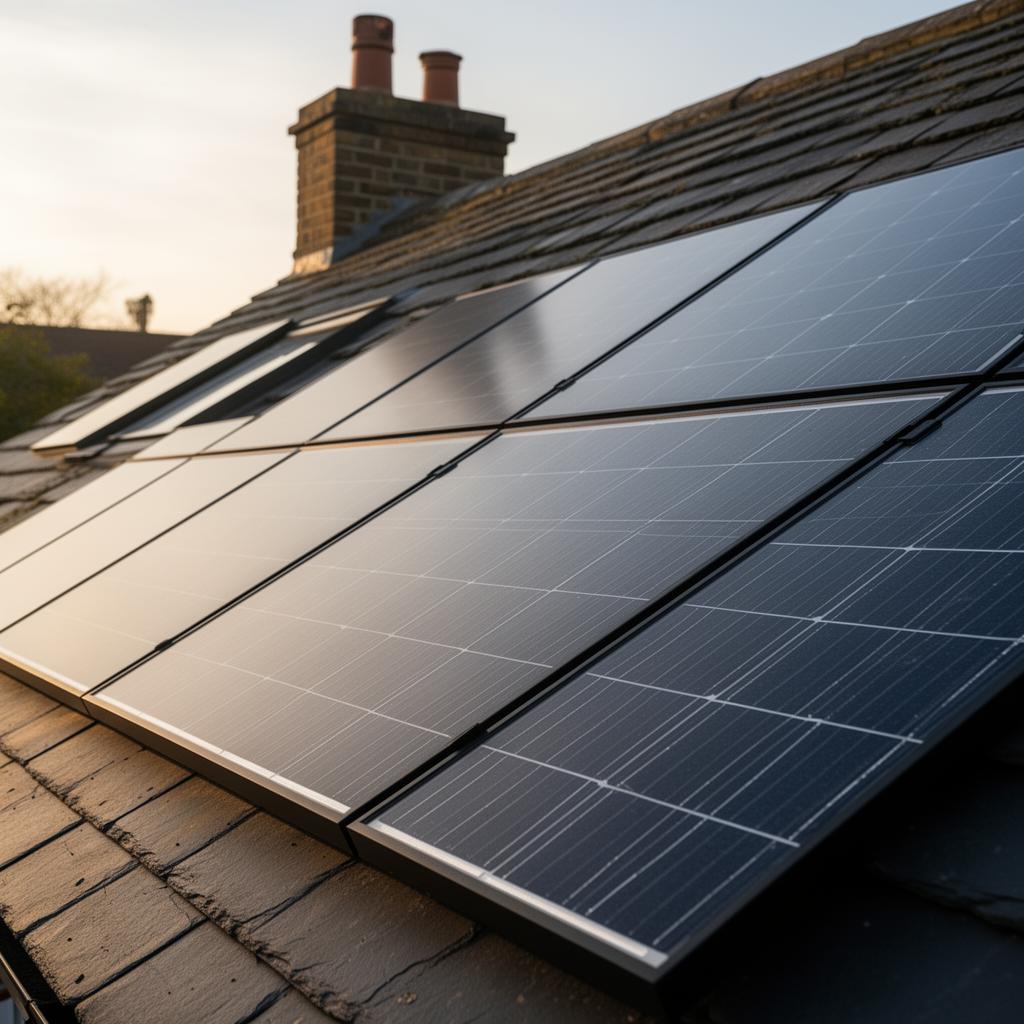
Quick answer: Yes, you can install solar on a slate roof, but expect to pay around 30% more than on a tiled roof. The Eco Experts puts an average slate job at £9,134 against £7,026 (The Eco Experts). The extra is labour, because every fixing means lifting nailed, brittle slates. If the roof needs work anyway, an in-roof system is usually the better route.
Slate doesn’t forgive a careless drill. But it isn’t a reason to skip solar either. What matters is which slate you have, how the installer fixes to it, and whether the roof will outlast the panels.
How much does it cost to install solar on a slate roof?
The most recent published comparison we could find is The Eco Experts’ average of £9,134 for a slate installation against £7,026 on a standard roof, roughly 30% more (The Eco Experts, page last updated April 2024). For current context, the 2025/26 median for a 0 to 4kW solar installation was £1,780 per kW, about £7,100 for 4kWp (DESNZ solar PV cost data). Add 30% and a slate job lands around £9,200.
Almost none of that premium is hardware. A replacement slate plate from Solar Slate Plate lists at £12 to £13 plus VAT, and its roof hooks at £6.75 plus VAT each (Solar Slate Plate). The money goes on time. The Eco Experts says a typical slate job runs around five days against one or two on a standard roof; Sunsave says one or two days longer than average (Sunsave, updated January 2026). Longer on the roof means longer scaffold hire too, which our scaffolding costs guide explains.
So a quote that’s only a few hundred pounds above a tiled-roof price should make you ask what’s been left out. Usually it’s the care.
Natural, fibre-cement or reconstituted: which slate have you got?
“Slate roof” covers three quite different products, and the right fixing depends on which one is up there.
| Slate type | How it’s fixed | Main solar risk | What usually works |
|---|---|---|---|
| Natural slate (Welsh, Spanish and other quarried slate) | Each slate nailed to the battens | Brittle, cracks if levered or drilled; matching replacements can be hard to find | Slate hooks fixed to the rafters with new flashing, or replacement plates |
| Fibre-cement (for example Marley Eternit) | Two copper nails plus a copper disc rivet at the tail | Roofs from before 2000 may contain asbestos | Asbestos check first, then hooks or plates sized to the slate |
| Reconstituted, interlocking (for example Redland Cambrian) | Nails and metal clips, interlocked top and sides | Very hard to replace once broken | In-roof, or a fixing system certified for that slate |
Natural slate is the classic problem. Sunsave’s summary is blunt: every slate is nailed in, so each has to be removed carefully, and the stone is more fragile than tile (Sunsave). On a Victorian or Edwardian roof, the nails and battens matter as much as the slate. A roof already shedding the odd slate (nail sickness) needs sorting before anything is bolted to it.
Fibre-cement slates are thinner, lighter and uniform. Marley’s fixing guide specifies two copper nails and a copper disc rivet per slate, and says roof windows and other penetrations shouldn’t be specified on its lowest-pitch fibre-cement roofs (15°, maximum 4m rafter) (Marley Eternit fixing guide). The bigger issue is age. HSE says asbestos can be present in any building built or refurbished before 2000, and lists asbestos cement roofing among its past uses (HSE). If your artificial slates predate 2000, get them tested before anyone cuts or drills them.
Reconstituted slate is the one people forget. Redland’s Cambrian is made with over 60% Ffestiniog Welsh slate and is compatible with Redland’s PV InDaX Adapt in-roof system (BMI Redland). Solar Limpets, which makes a slate fixing, warns that Cambrian slates are thin, clipped and “exceedingly difficult to replace”, and says the only alternative it knows of is an integrated panel system (Solar Limpets). On an interlocking slate roof, we’d start with in-roof.
How installers fix solar panels to slate
Slate hooks with new flashing
This is the standard method. Around each fixing point the installer frees the nails with a slate ripper and lifts the slates out whole, fixes flashing and a bracket with a standoff to the timbers, then cuts and refits the slates around it (The Eco Experts; Sunsave). The load ends up on the rafters and the weatherproofing is rebuilt, not punctured. Where battens are worn, hooks fixed straight to the rafters give better pull-out strength (Reonic).
Replacement flashing plates
Here a plate takes the place of one slate and carries the hook. Reonic describes these as lead or steel plates, useful for thin or brittle slate. Solar Slate Plate, a Redditch company, sells 13 sizes from 400mm to 600mm long and says its system needs no cutting and no sealants. One caveat on certification. MCS 012 is the standard for roof-mounting kits, and on 25 September 2026 the MCS Product Directory listed Solar Slate Plate as certified under a grace period (MCS IK0238/01). The company says MCS has extended that grace period beyond 10 August 2026 while it waits for the BBA to sign off its renewed certificate (Solar Slate Plate, July 2026 update). Whatever plate your installer uses, ask to see the current certificate.
Sealed through-fixings
Some systems do fix through the slate. Solar Limpets uses a baseplate with EPDM seals, drilled and screwed through the slate (Solar Limpets fitting notes), and covers natural and artificial slate. Its 20-year warranty applies only if the fixings are installed by people it has trained and certificated (Solar Limpets). That’s the line we’d draw. A certified sealed system fitted by a trained installer is a legitimate choice. Someone proposing to drill through your slates with a tube of mastic is proposing a future leak.
And one thing to refuse outright: tile hooks. They’re shaped for concrete and clay profiles and aren’t suitable for flat slate (Reonic).
Breakage risk and spare slates
Some breakage is normal on an old slate roof. What separates good installers is having an answer before it happens. Reonic’s installer guide says to keep a box of matching reclaimed slates on every slate job, because a cracked slate found at handover costs far more than one swapped during the fit (Reonic).
Two questions sort serious slate installers from optimists. Who physically reinstates the slates: a roofer on the team, or the electricians? And where does matching slate come from if any break? Colour-matching shows on a visible slope, and good reclaimed slate isn’t cheap. An installer with no answer to the second question hasn’t done many slate roofs.
Access matters too. On Cambrian slate, Solar Limpets tells installers to lay timbers across the hooks to move around and not to rely on the rails to take their weight (Solar Limpets). Expect scaffolding with a proper working platform on any slate job.
Is in-roof solar better on a slate roof?
Often, yes. In-roof panels sit in weatherproof trays that replace a section of slates, so nothing is hooked or drilled through the slate field and the finish sits flush. Viridian’s Clearline fusion is made to work with slate as well as tile (Viridian Solar), and Redland’s PV InDaX Adapt works with its Cambrian slate. There’s a neat side benefit on natural slate: the slates stripped out for the trays become your stock of matching spares.
The trade-off is heat. With less air behind them, integrated panels are about 3% less efficient according to The Eco Experts, or 5% to 10% according to Spirit Energy (Spirit Energy). On cost, in-roof is close to on-roof on a new roof and noticeably dearer as a retrofit. Our solar roof tiles and in-roof comparison puts numbers on that, and on solar slates.
Our position: if the slate roof needs work in the next few years, or it’s interlocking reconstituted slate, go in-roof and pay for the strip-back once. On a sound natural slate roof where output matters most, on-roof with proper slate hooks still wins.
Should you re-roof before fitting solar?
Panel warranties run for decades, so the roof underneath needs to last as long. Get a roofer to look at the nails, battens and membrane before the solar survey. Slipped or cracked slates, rusting nails and damp patches in the loft all point to work that’s cheaper to do first. Taking panels off later to re-roof is a cost in its own right, set out in our removal and reinstallation guide.
Listed buildings and conservation areas
Slate and conservation areas overlap heavily, but the rules are friendlier than people expect. In England, roof solar on a house is normally permitted development, updated on 27 August 2026 with a 12-month transition. Panels mustn’t project more than 200mm from the roof slope or sit above the highest part of the roof, excluding the chimney. In a conservation area or World Heritage Site they mustn’t go on a wall, balcony or roof enclosure fronting a highway (Planning Portal). Wales may differ.
Listed buildings are the exception. Works that affect a listed building’s character need consent (Planning (Listed Buildings and Conservation Areas) Act 1990, s.7), and there’s no guarantee of getting it. Talk to the council’s conservation officer before paying for a design, and don’t assume solar slates are the answer: Historic England says solar slates and tiles are generally not suitable for prominent roof slopes of listed buildings. Where a council will accept them, GB-Sol’s PV Slate is sized to match 500 x 250mm natural slates (GB-Sol). Our solar planning permission guide covers the rest.
What to ask a slate roof installer
- What fixing will you use, and can I see its current MCS 012 certificate?
- How many slate roofs have you done in the last year, and can I see photos?
- Who lifts and refits the slates, and where will replacements come from?
- Does your workmanship warranty cover weathertightness around the fixings, not only the electrics?
- If my slates are fibre-cement and pre-2000, who arranges the asbestos test?
- Can you price on-roof and in-roof side by side?
Only use an installer with current MCS certification, which you’ll also need for export payments. When you’re ready, request a free quote: up to three approved installers who cover your area may contact you. No charge, no obligation. Our solar panel guide covers system sizes and typical prices.
We compare published installer methods, prices and product terms rather than fitting systems ourselves, and this guide was checked in September 2026.
FAQs
Can you install solar panels on a slate roof?
Yes. Natural, fibre-cement and reconstituted slate roofs can all take solar, but each needs a fixing suited to it: slate hooks with new flashing, replacement plates, a certified sealed fixing, or an in-roof system.
How much more does solar cost on a slate roof?
Around 30% more than a tiled roof. The Eco Experts puts an average slate job at £9,134 against £7,026. The extra is mostly labour and longer scaffold hire, not hardware.
Will solar panels damage my slate roof?
Not if the installer knows slate. A few slates may crack during the work, which is why a good installer sources matching spares before starting and has a roofer refit them. Tile hooks and drilling with mastic are the methods that cause leaks.
Can panels go on natural slate without removing any slates?
Not with standard on-roof hooks: slates around each fixing have to come out and go back. The exceptions are certified sealed through-fixings fitted by trained installers, and in-roof systems, which replace a section of slates entirely.
Is in-roof solar a good idea on slate?
Often. It avoids fixing through the slate field and gives you spare slates, at the cost of about 3% to 10% of output. It’s the obvious choice if the roof needs work anyway or has interlocking reconstituted slates.
Getting paid enough for your exported power?
Export rates vary twenty-fold between suppliers. We rank every SEG and export tariff monthly, with the conditions attached to each.

Related Articles

Tesla Powerwall 3 vs GivEnergy All in One: what changed in 2026
Both store 13.5kWh of LFP. One discharges at 11.04kW, the other at 3.6kW, and only one is backed by a company still trading after GivEnergy entered administration in April 2026.
30 September 2026
Trina solar panels review UK: Vertex S+ specs, warranty and verdict
Trina's Vertex S+ 445W publishes 22.3% efficiency, 25-year product cover and a dual-glass build. We read the datasheet and say when it's worth specifying and when it isn't.
30 September 2026
JA Solar panels review UK: DeepBlue 4.0 Pro specs, warranty and price
JA Solar's DeepBlue 4.0 Pro publishes 22.8% efficiency, 25-year product cover and a 30-year performance warranty to 87.4%. We read the datasheet and the UK price list.
29 September 2026